strange-biology
Dispatch
New Caledonian crows manufacture hook tools from Pandanus leaves with standardized cuts. They solve novel problems and use tools to get tools.
strange-biology
Dispatch
Dragonflies catch prey in flight with a 95% success rate. They don't chase. They predict the interception point and fly directly to it.
Dispatch
strange-biology
Dispatch
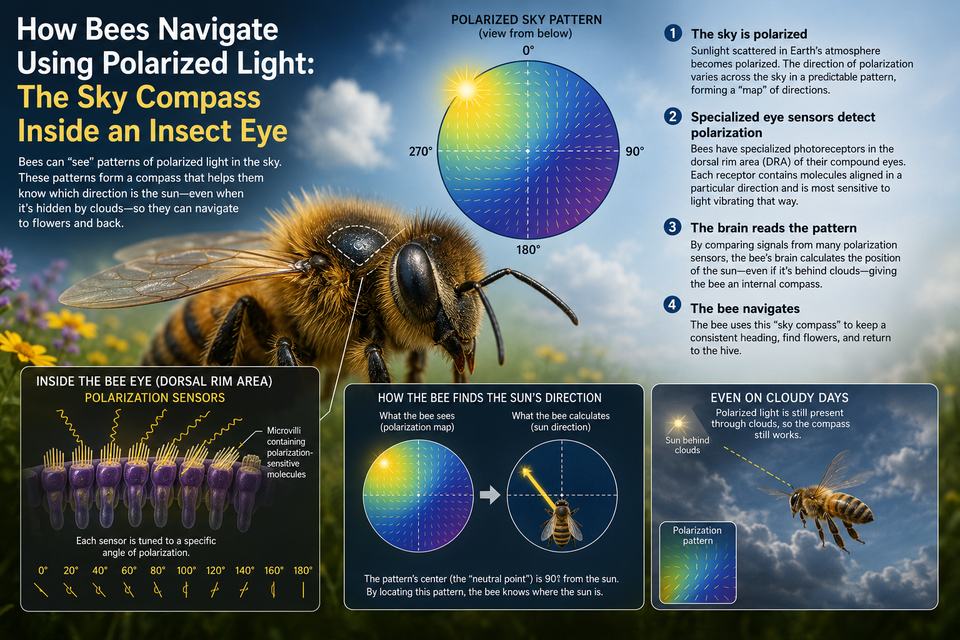
Honeybees detect the polarization pattern of sunlight scattered across the sky. Even under clouds, they read a compass humans cannot see.
strange-biology
Dispatch
Pacific salmon return to their birth stream with over 95% accuracy after years at sea. They use magnetic maps for the ocean and smell for the river. Two systems, one journey.
strange-biology
Dispatch
Dolphins can locate a fish-sized object from 100 meters and identify its species from the echo. The engineering inside a dolphin's head outperforms any man-made sonar at comparable scale.
strange-biology
Dispatch
Vampyroteuthis infernalis lives where almost nothing else can — the oxygen minimum zone. It survives by doing less than any other cephalopod: slower, softer, dimmer.
strange-biology
Dispatch
A pufferfish inflates by swallowing water into a specialized elastic stomach that has no digestive function. Collagen fibers in the skin stretch to three times their resting area without tearing.
strange-biology
Dispatch
Every injectable drug and medical device is tested using horseshoe crab blood. A 450-million-year-old immune response that clots on contact with bacterial endotoxin became modern medicine's safety net.
strange-biology
Dispatch
Pangolins are the only mammals with keratinous scales. The same protein as your fingernails becomes 3mm armor plates that overlap like roof tiles and can roll into a ball no predator can open.
strange-biology
Dispatch
Thousands of fireflies flash in unison with no conductor and no leader. Each individual adjusts its internal clock based on its neighbors, and group synchrony emerges from the mathematics of coupled oscillators.
strange-biology
Dispatch
Leafy seadragons grow elaborate appendages that mimic kelp fronds. The structures have no muscles and serve no purpose except vanishing into the canopy.
strange-biology
Dispatch
The mimic octopus doesn't just change color. It rearranges its entire body to impersonate lionfish, flatfish, and sea snakes, switching between disguises based on what's threatening it.