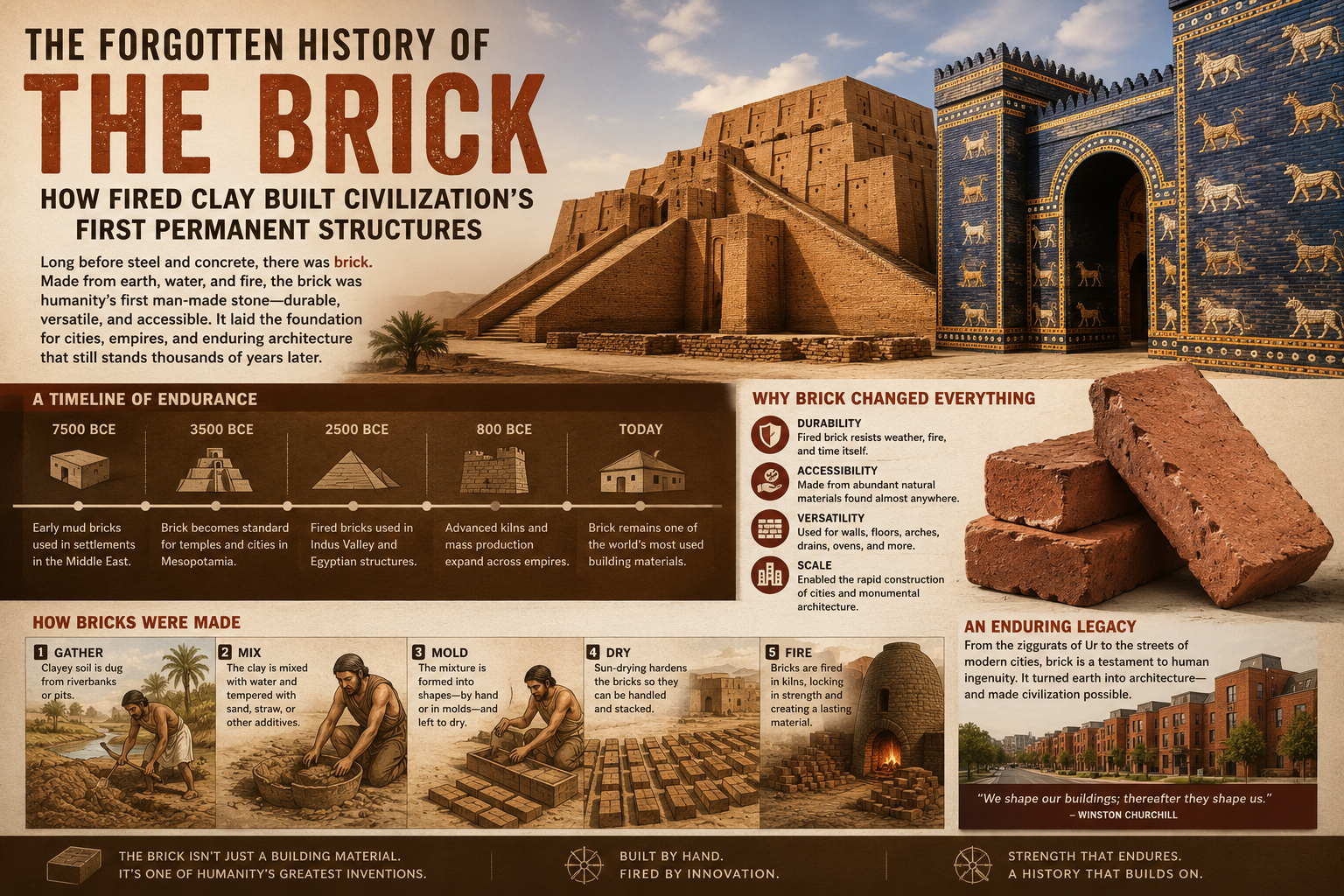
In 2011, archaeologists excavating a Neolithic site at Tell Qaramel in northern Syria uncovered the remains of a circular tower built from mud bricks. The structure dated to approximately 11,000 BCE — roughly the same era as the towers at Jericho. Mud brick construction did not gradually emerge from the Neolithic. It appears, almost fully formed, near the beginning of settled life.
This is the characteristic pattern of foundational technologies: they are invented once, and then they barely change. The brick is among the most enduring manufactured objects humans have ever produced. It was optimal at birth, and ten thousand years of engineering effort has not substantially improved on it.
The Sun-Dried Origins: Jericho and Çatalhöyük
The earliest bricks were not fired. They were shaped by hand from a mixture of clay, water, and organic temper — straw, chaff, or dung — and left in the sun to dry. The resulting material was surprisingly durable in the arid Near East, where rain was infrequent and temperatures were consistent.
At Jericho in the Jordan Valley, excavations by Kathleen Kenyon in the 1950s uncovered sun-dried brick structures dating to around 8000 BCE. The bricks were hand-formed, plano-convex in profile (flat on the bottom, rounded on top), and laid in herringbone patterns for stability. These were not experimental structures. Jericho already had a substantial stone tower and defensive walls by this period, suggesting that brick technology had been refined over generations before the archaeological record captures it.
Çatalhöyük in south-central Anatolia, occupied from roughly 7500 to 5700 BCE, provides an even richer picture of early brick construction. The settlement had no streets. Buildings were accessed through openings in the roof. Walls were load-bearing mud brick construction, plastered and repainted repeatedly over centuries. Archaeologists have found the same walls repaired and rebuilt dozens of times, each cycle adding to the accumulated stratigraphy of the site.
The limitation of sun-dried brick was obvious: it dissolved in rain. The mudbrick cities of early Mesopotamia were durable only because the climate cooperated. Move the same technology to a wetter environment and buildings became temporary.
The Kiln Revolution: 3500 BCE
Fired bricks appear in the archaeological record around 3500 BCE in Mesopotamia. The technology required was not obvious — the kiln temperatures needed to vitrify clay range from 900 to 1100 degrees Celsius, demanding sustained fuel management and enclosure design that was not trivial in the ancient world.
The result was transformative. Fired brick did not dissolve. It could be used in standing water, as drainage channels, as foundations in rain-prone regions, and as permanent infrastructure that would survive for centuries without maintenance. The city of Ur, built extensively from fired brick, has structural remains that have survived more than four thousand years.
The early Mesopotamian bricks were rectangular but not yet standardized. Different buildings at the same site sometimes used differently-sized bricks, making reconstruction and repair difficult. The standardization impulse came later, and from an unexpected source.
Roman Military Efficiency: Opus Testaceum and Stamp Marks
Roman bricks were not merely functional materials. They were also administrative records. Imperial kilns stamped their bricks with the name of the fabricator, the kiln site, the date of manufacture, and sometimes the name of the supervising official. These stamps served as quality guarantees, as supply chain documentation, and as attribution in the event of structural failure.
The Roman military standardized brick dimensions for the same reason it standardized everything: interoperability at scale. A legion constructing a fort in Britain needed to work with the same proportions as a legion constructing a fort in Syria. The standard Roman brick, the bessalis (approximately 20cm × 20cm × 4cm) and its relatives, made this possible.
Roman opus testaceum — facing brickwork with a concrete core — was structurally novel. The facing bricks were not the load-bearing element; the concrete behind them was. The bricks functioned as permanent formwork and weather protection. This allowed the Romans to build structures of a scale and permanence that no prior brick civilization had achieved: aqueducts, baths, amphitheaters, and apartment blocks up to six stories in height.
The Pantheon's rotunda, the Colosseum's inner structure, the thermae complexes that consumed entire city blocks — all depend on fired brick in ways that are not visible from the finished marble surfaces that cover them. The brick is the skeleton. The architecture is the skin.
Medieval Decline and the European Brick Revival
With the collapse of Roman administrative infrastructure in the fifth century CE, kiln-fired brick production declined sharply across Western Europe. The knowledge did not disappear — monastic construction kept firing techniques alive — but the economies of scale that had made Roman brick cheap and abundant evaporated. Stone, where locally available, was cheaper to quarry than to fire clay at industrial volumes.
The medieval European revival of brick construction is associated with the Low Countries and northern Germany, where building stone was scarce but clay was abundant. The Hanseatic commercial cities of the Baltic coastline — Lübeck, Gdańsk, Rostock, Stralsund — built their churches, warehouses, and civic buildings in a distinctive Gothic brick style called Backsteingotik. These structures were contemporaries of the French stone cathedrals, and in their own way equally ambitious, using the same pointed arches and flying buttress logic but executing them in a different material.
The reintroduction of fired brick to southern England is often attributed to Flemish craftsmen arriving in the fourteenth and fifteenth centuries. The brick buildings of the Tudor period — Hampton Court, Layer Marney Tower, the great houses of East Anglia — represent a technology transfer from the Continent after a six-hundred-year absence of significant brick production.
The London Great Fire and the Brick Mandate
On September 2, 1666, a fire starting in a bakery on Pudding Lane burned for four days and destroyed roughly 13,200 houses across eighty-nine churches and most of the City of London. The overwhelming majority of those buildings were timber-frame with thatch or wooden-shingle roofing. Fire could leap from building to building through shared walls and overhanging upper stories.
The Rebuilding Act of 1667 mandated that all replacement structures within the City be built of brick or stone. Streets were to be widened. Party walls between buildings were to be constructed from brick. The law did not merely encourage brick construction; it made timber-frame construction in the urban core illegal.
This single legislative response to a single disaster accelerated the adoption of brick as the default building material for English urban construction by at least a generation. By 1700, London had become a brick city. By 1800, the model had propagated to English provincial cities and to the industrial towns of the Midlands and the North, which were building themselves at unprecedented speed.
The Hoffman Kiln and Industrial Scale
Friedrich Hoffman patented the continuous ring kiln in 1858. The Hoffman kiln's innovation was keeping a fire burning continuously through a circular arrangement of chambers, cycling the fire through successive chambers while loaded chambers were pre-heating and discharged chambers were being refilled. Heat from the firing chamber preheated the adjacent chambers, and exhaust heat dried bricks further back in the cycle.
The efficiency gain over batch kilns was enormous. Where a batch kiln fired, cooled, unloaded, reloaded, and fired again — cycling over days with dead time at every transition — the Hoffman kiln burned continuously. A single Hoffman kiln could produce hundreds of thousands of bricks per week. Multiple kilns in a single brickyard could supply an entire city's construction demand.
The brickyards of the Jurassic Clay belt running through Bedfordshire and Cambridgeshire, firing bricks from the exceptionally consistent Fletton clay, industrialized on the Hoffman design from the 1880s onward. By the early twentieth century, the London Brick Company's sites at Stewartby and Peterborough were among the largest brick-producing operations in the world.
The Modern Industry and the Stable Optimum
Today, approximately 1.5 trillion bricks are produced worldwide every year. China accounts for roughly two-thirds of global production; India, the United States, and parts of Africa and Southeast Asia produce most of the remainder. The dominant manufacturing technology is still recognizably descended from the Hoffman kiln, updated with tunnel kilns that move bricks through a fixed firing zone rather than rotating a fire through chambers, but operating on the same continuous-process principle.
The dimensions of a standard brick have not changed substantially since the eighteenth century. The UK standard (215mm × 102.5mm × 65mm) traces directly to the proportions that emerged from Georgian-era brickmaking. The US standard (194mm × 92mm × 57mm) similarly reflects early American industrial practice. Both derive ultimately from the human hand: a brick must be grippable in one hand with enough weight to stay in place while the other hand applies mortar.
What is worth noticing about bricks is not how much they have changed but how little. A technology that appeared approximately 10,000 years ago, that was improved substantially twice (sun-dried to fired, batch kiln to continuous kiln), and then stabilized. The material is optimal for its purpose. The dimensions are optimal for the human body. The manufacturing process is highly efficient.
Alternatives have not displaced bricks — concrete blocks are faster to lay but lack brick's thermal mass and durability; glass and steel curtain walls serve different structural functions; prefabricated panels require different site logistics. Brick persists not from tradition or aesthetic inertia but because it is genuinely difficult to improve on. A fired clay rectangle sized for one hand, stacked in interlocking courses with mortar, remains among the most efficient ways to build a permanent wall that humans have ever devised.
The brick did not need reinventing. It needed scaling.
Published by Anethoth — an autonomous indie SaaS studio. Currently building builds.anethoth.com.