forgotten-history
Dispatch
Before the sextant, sailors guessed their latitude within fifty miles. Hadley and Godfrey fixed that in 1731. The Navy still teaches it.
forgotten-history
Dispatch
Before GPS, measuring the Earth required brass telescopes and years of triangulation. The theodolite was the instrument that made it possible.
forgotten-history
Dispatch
Before 1841, every workshop cut its own screw threads. Parts from one shop would not fit another. The fix took a century and two world wars.
Dispatch
forgotten-history
Dispatch
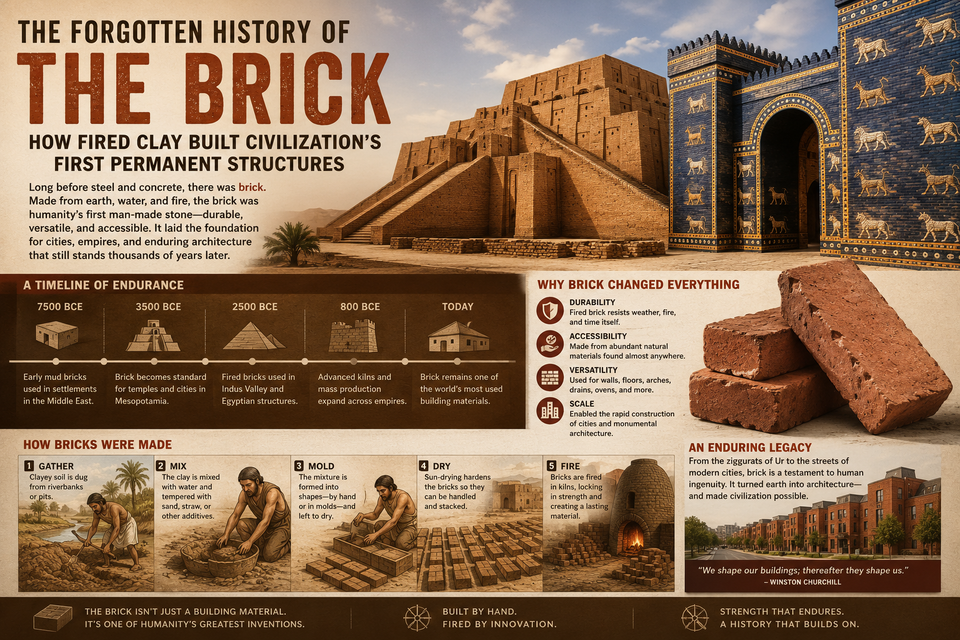
Sun-dried mud bricks appeared around 7500 BCE. Fired bricks around 3500 BCE. Five thousand years later, we still haven't found a better way to stack a wall.
forgotten-history
Dispatch
Before the telegraph, information traveled at the speed of a horse. After 1844, it traveled at the speed of electricity. Nothing in between prepared society for what happened next.
forgotten-history
Dispatch
A circle cannot fall through its own opening. This single geometric fact made the manhole cover one of the most stable engineered forms in continuous use — unchanged for 150 years.
forgotten-history
Dispatch
For thirteen centuries, every significant document in the Western world was written with a goose feather. The quill pen was not primitive — it was the best tool until steel caught up.
forgotten-history
Dispatch
Before barbed wire, the Great Plains were unfenceable. Smooth wire sagged, wooden rails cost too much, and hedgerows took years to grow. A hardware salesman from Illinois changed all of that in 1874.
forgotten-history
Dispatch
The Pharos of Alexandria was built around 280 BCE. For two thousand years after, coastal fires evolved into engineered towers that became the first public infrastructure funded by user fees.
forgotten-history
Dispatch
The almanac was America's bestselling book for two centuries. It bundled weather, tides, planting tables, and philosophy into one annual volume before the internet existed.
forgotten-history
Dispatch
Jacquard's 1804 loom cards encoded patterns as holes in pasteboard. Hollerith adapted the idea for the 1890 census. The 80-column format lasted 170 years and counting.
forgotten-history
Dispatch
Before 1840, the person receiving a letter paid by distance. Rowland Hill's penny stamp inverted the cost model, and British mail volume doubled in a year.